


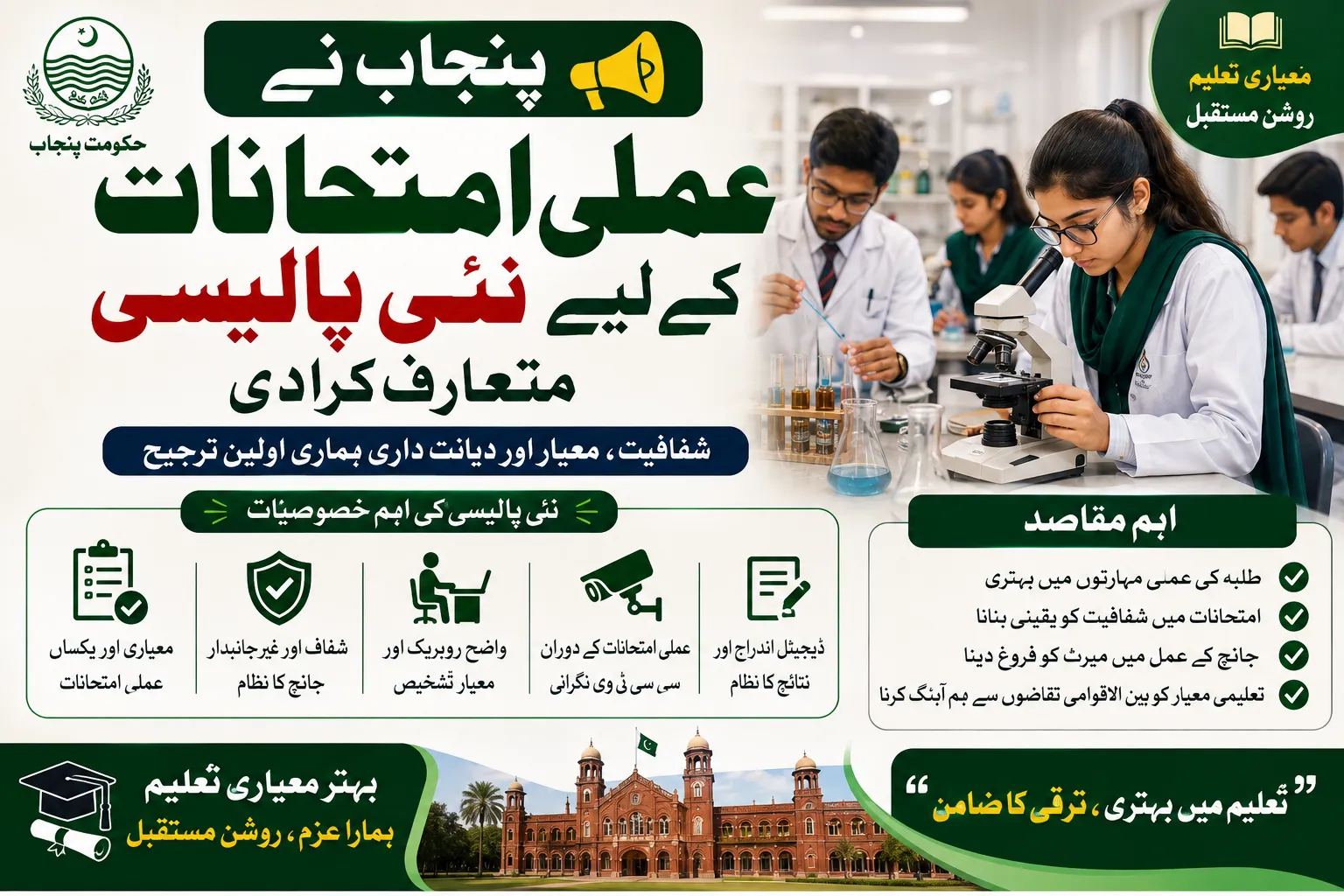
The education boards of Punjab have announced a new policy for practical exams, which will help to improve the assessment system in the province. The revised system will see the written component of practical exams moderated centrally at Board level rather than by examiners at the exam center level.
For the practical examinations in Physics, Chemistry, Biology and Computer Science, the reform will be implemented. The new system is seen to enhance monitoring and the accuracy of student performance in practical marks.
Why Punjab Changed the Practical Exam System
The judgment follows a concern over unusually high practical marks being given to some students while their theory marks appeared weak.
The former system provided few measures of assurance over the practical testing process and might leave discrepancies between exam centres, education officials said. The new arrangement will aim to create a uniform system of marking for all boards of Punjab.
The policy has been changed, so students will take the practical part of the exam as it was previously, but the written element will be taken and marked at the board level.
Written Test to Be Checked Centrally
Students appearing in the practical exams of Physics, Chemistry, Biology, Computer Science will now have to face a written test as well as experiment and viva voce.
Students’ answer sheets will be picked up by the relevant education boards after the examination. These papers will then be handed to qualified examiners for collective marking.
This implies that the focus of practical examination centers will be on assessing the following:
- Laboratory work
- Practical skills
- Experiments
- Viva voce performance
The written paper, on the other hand, will be assessed by the relevant education board’s examiners.
New System Aims to Improve Transparency
The officials feel that the differences between the practical marks given at various examination centres will be reduced due to centralised marking.
The new system would enable the education boards to also have a better control on the written portion, and to be able to review the answer sheets more effectively if a student or teacher has an objection in regard to marking, said a senior official of the Lahore Board.
The reform will also help boards detect irregular patterns of marking and enhance the monitoring of practical exams.
Students Will Have Three Assessment Components
The revised approach will allow students to be assessed during practical examinations through three key areas, which will be effective:
- Written Test – Assessed centrally by the education board.
- Practical/Experiment – Evaluated at the examination center.
- Viva Voce – Assessed by the practical examiner.
The overall assessment is designed to give a more holistic view of a student’s knowledge and application skills.
Education Experts Welcome the Reform
The shift is generally welcomed by education professionals as a positive measure to enhance the authenticity of board exams.
Practical marks can have a significant impact on students’ overall grades, particularly in science subjects. A central assessment of the written element may be helpful to ensure that pupils are awarded marks based on their actual performance and not on discrepancies in marking across examination centers, experts believe.
The policy may also help alleviate concerns from students and parents on the lack of consistency in practical examination outcomes.
Students Seek Clear Guidelines
The new policy has been welcomed, however pupils have asked for clarification prior to upcoming tests.
They wish that education boards would release sample papers, marking schemes, practical examination guidelines and information about the new written-test format far in advance.
Students would have a clear understanding of how the written component is to be structured and how it will contribute to their overall practical marks if clear guidance were provided.
What the New Practical Exam Policy Means for Students
The updated system implies that students should complete their practical exams with a more comprehensive preparation. Candidates are not to limit their preparation to just experiments and viva voce but will also have to prepare for the written part.
Students are therefore advised to revise:
- Important practical concepts
- Laboratory procedures
- Experimental methods
- Calculations and observations
- Diagrams and practical-related questions
- Viva voce questions
- Written explanations of experiments
The new practical examination system was introduced in the education system in Punjab that has caused a fundamental shift in the system of evaluation for science and computer science students. The education boards want to make marking more transparent, consistent and accountable by moving the written mark-up to board level and retaining practical and viva assessment at examination centers.
Effective implementation is essential, trained examiners, clear guidelines, and communication with students and teachers are necessary to ensure that the reform is a success. With proper implementation, the new system could contribute to building trust in the board examination process in Punjab, and help ensure that the practical marks more accurately reflect student knowledge and skills.
